Building materials yard safety: protecting teams in high-traffic environments
Updated: Apr 14
What makes building materials yards uniquely risky
Most industrial safety guidance is written for enclosed warehouse environments. Building materials yards share some of those hazards but add a layer of complexity that makes them harder to manage.
Vehicle and pedestrian traffic that you can't fully separate
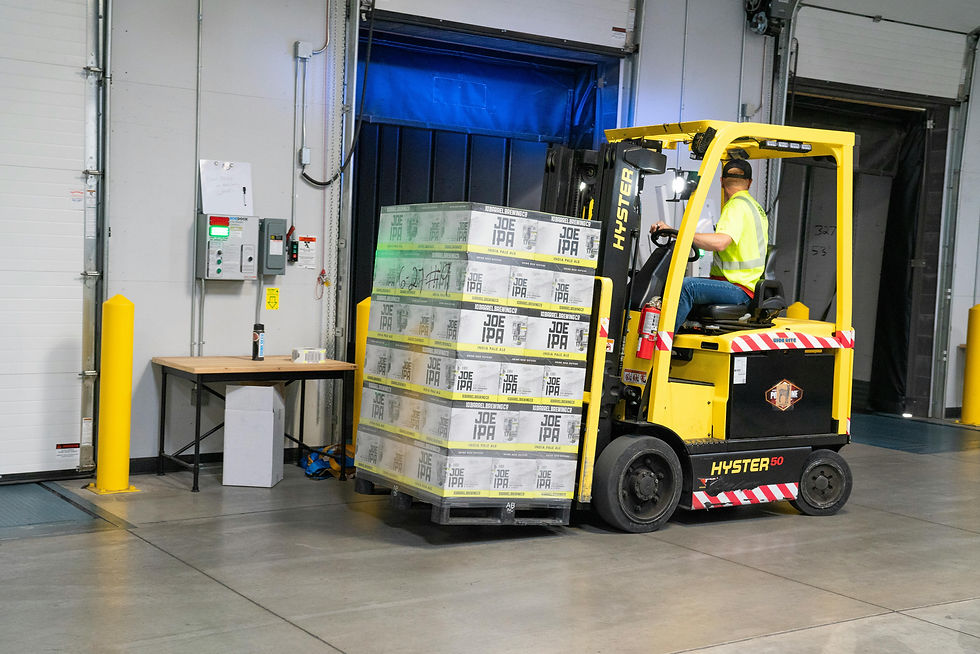
The defining challenge of a building materials yard is mixed traffic. Forklifts are moving heavy, oversized loads through the same spaces where staff and customers are on foot. OSHA data consistently shows that pedestrian-forklift interactions are among the most dangerous scenarios in any industrial setting. Nationally, 36% of all forklift-related fatalities involve pedestrians, and forklifts were the source of 84 work-related deaths in the US in 2024 alone.
In a building materials yard, this risk is amplified because customers routinely walk through the yard to select or inspect materials. Unlike a warehouse where access can be restricted to trained staff, a yard often has trade customers moving freely through areas where forklifts are operating. WorkSafe NZ has recommended that yards consider requiring customers to stay in their vehicles until loading or unloading is complete, but in practice many sites still allow open access.

Falling and shifting materials
Building materials are heavy, awkward, and often stored at height. Timber, steel, piping, roofing, and sheet goods are typically stored on cantilever racking or in stacked bundles, sometimes three metres or more above the ground. When a forklift lifts one pack, adjacent materials can shift or dislodge, as the WorkSafe NZ case demonstrated.
The lumber industry recognises falling objects as one of its top four hazards, alongside machinery, caught-in dangers, and hazardous substance exposure. The risk is highest during picking and loading, when materials are being moved and the people nearby may not realise the danger.

Blind spots and limited visibility
Large stacked materials, racking structures, parked trucks, and shipping containers all create blind spots that make it difficult for forklift operators and pedestrians to see each other. Add to that the noise of an operating yard, where a person on foot might not hear a forklift approaching until it's already close, and you have a persistent visibility problem that mirrors, signage, and good intentions alone can't fully solve.
Weather and surface conditions
Unlike an enclosed warehouse, a building materials yard is exposed to the elements. Rain makes surfaces slippery. Sun creates glare that reduces visibility. Wind can shift loosely stacked materials. Seasonal changes affect ground conditions, and many yards operate on surfaces that range from sealed concrete to loose gravel. These factors all increase the baseline risk of vehicle operations and manual handling.
Variable workforce and customer behaviour
Building materials yards often have a mix of experienced permanent staff, newer employees, seasonal workers, and customers who may have no safety training at all. This variability means that even strong safety procedures can break down when someone unfamiliar with the site walks into a high-risk zone without realising it.
Where traditional safety measures fall short
Most building materials operators invest in the standard controls: speed limits, designated pedestrian zones, floor markings, mirrors at intersections, staff training, and signage. These are all important, and they form the foundation of any safety programme.
But they share a common limitation: they rely on every person in the yard following the rules, every time, across every shift. In a busy yard with multiple vehicle movements, customer arrivals, and loading activities happening simultaneously, compliance is inconsistent. A supervisor might see a near miss during their walk-through, but they can't see the three that happened when they weren't looking.
The deeper problem is a lack of continuous visibility. Without knowing where near misses are occurring, how often, and what patterns they follow, safety teams are making decisions based on incomplete information.
How computer vision AI addresses the gap
Computer vision AI uses your existing CCTV cameras to monitor high-risk areas of the yard continuously, detecting safety events like pedestrian-vehicle near misses, exclusion zone breaches, and speed violations across every shift without relying on anyone to notice or report them.
Continuous monitoring of the areas that matter most
You don't need cameras on every square metre of the yard. The system focuses on your highest-risk zones: the areas where forklifts and pedestrians intersect, where materials are picked and loaded, and where delivery vehicles enter and exit. These are the zones where the overwhelming majority of serious incidents occur, and they're the zones where traditional visibility is weakest.
Pattern recognition that reveals hidden risk
One of the most powerful capabilities of computer vision AI is its ability to reveal risk you didn't know existed. The heatmap and reporting tools aggregate safety events over time, showing you exactly where, when, and how often near misses are occurring.
Many inviol customers discover that their yard layouts or operational schedules are creating more risk than they expected. A delivery truck timing that overlaps with a customer collection window. A blind corner near the timber racks that generates three times the near-miss rate of anywhere else on site. A particular forklift route that brings vehicles too close to a pedestrian zone during morning peak.
These patterns are invisible to any single walk-through or audit. But once you can see them, you can act on them, often with simple process changes that improve both safety and operational efficiency.
From events to coaching conversations
Detection alone isn't enough. What matters is what happens after a safety event is captured. inviol is built around a coaching-first approach: each event becomes the starting point for a team conversation about what happened, what could have gone wrong, and what should change.
Video clips are privacy-protected with face blurring, so the conversation is never about blaming an individual. It's about improving the process. Over time, this builds a safety culture where workers engage with the system because they see it as a tool for their protection, not surveillance.
inviol customers typically see an average 67% reduction in risk and a 42% reduction in incidents, with PlaceMakers achieving an 80% reduction in vehicle-related risk.

Compliance and your obligations
Under New Zealand's Health and Safety at Work Act (HSWA), PCBUs have a duty to eliminate or minimise risks so far as is reasonably practicable. For a building materials yard, that means proactively identifying and managing the risks created by mixed traffic, heavy materials handling, and public access. A system that continuously monitors your highest-risk zones and documents how safety events are identified, coached, and resolved strengthens your compliance position significantly.
In Australia, Safe Work Australia reports that 76% of work-related fatalities occur in just six industries, with manufacturing, construction, and transport among them. Building materials yards sit at the intersection of all three.
In the US, OSHA requires employers to provide a workplace free from recognised hazards and mandates specific training and operational controls for powered industrial trucks. Demonstrating that you're using technology to proactively manage forklift-pedestrian risk goes beyond minimum compliance.
Getting started
If you operate a building materials yard, start by identifying the two or three zones where vehicle and pedestrian traffic most frequently overlap. Ask yourself whether you have genuine visibility into what's happening in those zones across every hour of operation. If the answer is no, that's where computer vision AI can make the biggest difference.
The system works with your existing CCTV cameras, processes data on-premise so sensitive footage never leaves your site, and gives your safety team the leading indicators they need to prevent the next incident rather than react to the last one.
Book a demo and we'll show you how it works on a site like yours.
Frequently Asked Questions
What are the biggest safety risks in a building materials yard?
The biggest risks include forklift-pedestrian interactions in shared traffic zones, falling or shifting materials from cantilever racking and stacked bundles, blind spots created by large stored materials and parked vehicles, variable surface conditions in outdoor environments, and the presence of untrained customers in operational areas.
How can AI improve safety in a building materials yard?
Computer vision AI uses existing CCTV cameras to continuously monitor high-risk zones for safety events like near misses, exclusion zone breaches, and vehicle speed violations. It captures events across every shift and generates heatmaps that reveal risk patterns invisible to manual walk-throughs, enabling targeted process improvements.
Do building materials yards need to prevent customer access to forklift operating areas?
WorkSafe New Zealand recommends that yards consider requiring customers to stay in their vehicles when heavy machinery is operating. At minimum, yards should have clear exclusion zones, trained staff to manage customer movements, and systems to monitor compliance with pedestrian safety rules.
What are PCBU obligations for building materials yards under HSWA?
Under the Health and Safety at Work Act, PCBUs must eliminate or minimise workplace risks so far as is reasonably practicable. This includes managing the specific hazards of mixed vehicle-pedestrian traffic, heavy materials handling, and public access. Continuous monitoring and documented coaching demonstrate proactive risk management.
How quickly can a building materials yard see results from AI safety monitoring?
Results can be rapid. PlaceMakers, New Zealand's largest building materials supplier, achieved an 80% reduction in vehicle-related risk with inviol. The coaching-first approach means improvements compound as teams build safer habits through regular conversations about safety events.