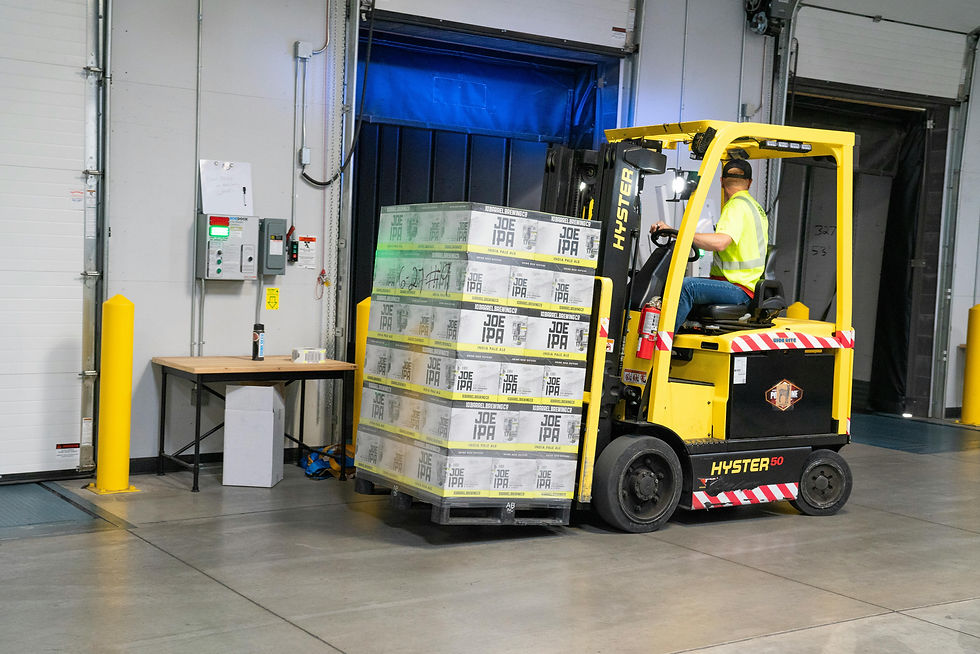
Electric forklifts and safety: does the shift to electric change risk?
Updated: Apr 10
The shift to electric forklifts is accelerating. The global electric forklift market was valued at over USD 50 billion in 2024 and is projected to more than double by 2030, according to industry analysis. Over 68% of European warehouses now operate fully electric forklift fleets, and lithium-ion models accounted for 63% of new forklift launches globally in 2024–2025.
The reasons are straightforward — zero emissions, lower operating costs, reduced maintenance, and quieter operation. But for safety managers, the transition raises an important question: does switching from internal combustion to electric change the risk profile of your operation?
The short answer is yes — but not in the way many people expect. Electric forklifts eliminate some hazards entirely, introduce a couple of new ones, and leave the most dangerous risks completely unchanged.
What electric forklifts eliminate
The most significant safety gain from going electric is the removal of carbon monoxide and exhaust emissions. OSHA's eTool guidance on enclosed and hazardous areas warns that internal combustion forklifts can cause dangerous carbon monoxide levels in enclosed spaces, potentially leading to unconsciousness and death. The standard recommends that operations with significant indoor work consider switching to battery-powered forklifts to reduce this risk.
For warehouses, cold stores, and food manufacturing environments, this alone can be transformative. No exhaust means no ventilation constraints, no exposure monitoring for carbon monoxide, and no risk of diesel particulate accumulation. Workers breathe cleaner air, and operators are not exposed to engine vibration or fuel-related hazards.
The other eliminated hazard is fuel handling. Diesel spills, LPG cylinder changeovers, and fuel storage requirements all disappear with an electric fleet. Each of these carries its own injury risk — burns, slips, manual handling injuries — that simply no longer applies.
What electric forklifts change
The most discussed change is noise — or rather, the lack of it. Electric forklifts are significantly quieter than their diesel or LPG equivalents. This is genuinely beneficial for operator health (reduced noise-related fatigue, no hearing damage risk from prolonged exposure) and for workplace communication.
But it introduces a real pedestrian safety concern. Workers who have spent years instinctively listening for the rumble of an approaching engine now cannot hear an electric forklift until it is very close. The University of Salford, commissioned by building materials supplier Travis Perkins, is researching audible alert systems specifically because workers raised safety concerns about the quietness of their new electric forklifts. The study aims to develop a new standard for electric forklift sound alerts that balances detectability for pedestrians with comfort for operators.
This is not a theoretical risk. OSHA data shows that 36% of forklift fatalities involve pedestrians, and the BLS reports that pedestrian forklift injuries require a median of 20 days away from work — more than double the average for all workplace injuries. If the primary audible warning of an approaching forklift is removed, the risk of pedestrian-vehicle interaction incidents could increase unless compensating controls are in place.
Battery management is the other changed risk. While lithium-ion batteries eliminate the need for daily watering, acid handling, and frequent battery swapping associated with traditional lead-acid batteries, they bring their own considerations. OSHA has published specific guidance on lithium-ion battery safety, covering thermal runaway risks, proper charging procedures, and storage requirements. The good news is that lithium iron phosphate (LFP) cells — the dominant chemistry in industrial forklifts — have a significantly higher thermal runaway threshold than other lithium chemistries, and established brands on the market comply with UL safety standards with zero incident reports in OSHA statistics.
OSHA's eTool on electric forklift power sources still emphasises the importance of proper battery maintenance programmes, adequate ventilation during charging (particularly for older lead-acid batteries), and training for personnel who handle batteries. The Severe Injury Reports that OSHA has collected since 2015 recorded just 52 incidents related to forklift battery handling out of over 60,000 total reports — less than 0.1% — but those injuries included fractures, crush injuries, and acid burns from lead-acid batteries.
What does not change at all
Here is the critical point that gets lost in the electric versus combustion discussion: the most dangerous risks associated with forklifts have nothing to do with the power source.
A forklift that weighs 4,000 kilograms is equally lethal whether it runs on diesel, LPG, or lithium-ion batteries. The physics of a pedestrian being struck, a forklift overturning at a blind corner, or a load falling from height do not change with the drivetrain.
The National Safety Council reports that forklifts were the source of 84 work-related deaths in the United States in 2024 and over 25,000 DART cases in 2023–2024. OSHA estimates that between 35,000 and 62,000 injuries occur every year involving powered industrial trucks. The leading causes — pedestrians struck, tip-overs, crush injuries, falling loads — are all power-source agnostic. An OSHA enforcement directive confirms that pedestrians being struck remains the number one cause of forklift-related work fatalities regardless of vehicle type.
In New Zealand, WorkSafe has been clear that forklifts are a known critical risk that too many businesses fail to adequately manage. The Health and Safety at Work Act 2015 requires PCBUs to manage vehicle-pedestrian interaction risks regardless of the vehicle's power source. In Australia, Safe Work Australia's Key WHS Statistics 2025 report found vehicle incidents accounted for 42% of all worker fatalities in 2024, with at least one vehicle involved in 66% of all workplace deaths.
The transition to electric does not reduce these risks by a single percentage point. If anything, the quieter operation of electric forklifts may marginally increase pedestrian interaction risk in the absence of compensating controls.

Why continuous monitoring matters more with electric fleets
This is where the conversation shifts from "which forklift should we buy?" to "how do we manage risk regardless of what we buy?"
Because electric forklifts are quieter, the traditional audible cue that warned pedestrians of an approaching vehicle is diminished. This makes visual detection, exclusion zone enforcement, and near-miss monitoring more important than ever. Computer vision AI fills this gap by providing continuous, power-source-independent monitoring of every vehicle-pedestrian interaction across your site.
inviol's system does not care whether the forklift is electric, diesel, or LPG. It monitors the interactions between vehicles and people using your existing CCTV cameras — capturing near misses, exclusion zone breaches, speed events, and unsafe behaviours regardless of the drivetrain underneath. The heatmap feature reveals whether the introduction of quieter electric forklifts has changed pedestrian interaction patterns at specific intersections or zones — data that would be invisible without continuous monitoring.
For operations transitioning from combustion to electric, this before-and-after visibility is invaluable. You can measure whether near-miss rates at blind corners have changed since the new fleet arrived. You can see whether pedestrians are less aware of approaching vehicles in specific zones. And you can use the coaching platform to address emerging risks with targeted, evidence-based conversations — faces blurred for privacy, focused on the behaviour and the environment.
inviol customers typically see a 67% reduction in risk through this coaching-first approach — a reduction that applies to electric and combustion fleets alike, because the underlying risks are the same.

Making the transition safely
If you are planning or mid-way through an electric fleet transition, the safety checklist is straightforward. Address the new noise risk with audible alert systems, blue spot lights, or proximity detection technology on your electric forklifts. Review your traffic management plan to ensure pedestrian separation controls are adequate for quieter vehicles. Ensure charging areas meet OSHA, WorkSafe NZ, or relevant Australian WHS requirements. Train all staff — not just operators — on the changed sound profile of electric forklifts.
And critically, do not assume that going electric has made your operation safer overall. The biggest risks remain pedestrian-vehicle interactions, blind corners, speed, and human behaviour — and these need continuous monitoring and coaching regardless of what powers your fleet.
If you want to see how your current risk profile looks across your fleet — electric, combustion, or mixed — book a demo and see inviol's monitoring and coaching platform in action.

Frequently Asked Questions
Are electric forklifts safer than diesel or LPG forklifts?
Electric forklifts eliminate emission-related hazards (carbon monoxide, diesel particulates) and fuel handling risks, making them safer in those specific areas. However, the most dangerous forklift risks — pedestrian collisions, tip-overs, and falling loads — are identical regardless of power source. The quieter operation of electric forklifts may also increase pedestrian interaction risk unless compensating controls like audible alerts or continuous monitoring are in place.
What is the main new safety risk with electric forklifts?
The most significant new risk is reduced audibility. Electric forklifts are substantially quieter than combustion models, meaning pedestrians may not hear an approaching vehicle. Research commissioned by Travis Perkins and conducted by the University of Salford is developing new audible alert standards specifically to address this concern. Visual warnings like blue spot lights, proximity detection systems, and continuous monitoring with computer vision AI all help compensate.
Do electric forklift batteries pose a safety risk?
Modern lithium iron phosphate (LFP) batteries used in industrial forklifts have excellent safety profiles, with zero incident reports in OSHA statistics for established brands. OSHA has published specific guidance on lithium-ion battery safety. The main battery-related risks from older lead-acid technology — acid burns, hydrogen gas buildup during charging, and crush injuries from heavy battery swapping — are largely eliminated with lithium-ion systems.
Does switching to electric forklifts reduce the need for safety monitoring?
No. The leading causes of forklift injuries and fatalities — pedestrian-vehicle collisions, blind corner incidents, speeding, and tip-overs — are power-source independent. Computer vision AI monitors vehicle-pedestrian interactions regardless of the forklift type, and is particularly valuable for electric fleets where the reduced noise profile may change pedestrian awareness patterns.
What regulations apply to electric forklifts?
OSHA's powered industrial trucks standard (29 CFR 1910.178) applies to all forklifts regardless of power source, covering operator training, safe operation, and battery charging requirements. In New Zealand, the HSWA 2015 requires PCBUs to manage vehicle risks regardless of drivetrain. OSHA also has specific guidance on electric forklift battery charging and on lithium-ion battery safety.