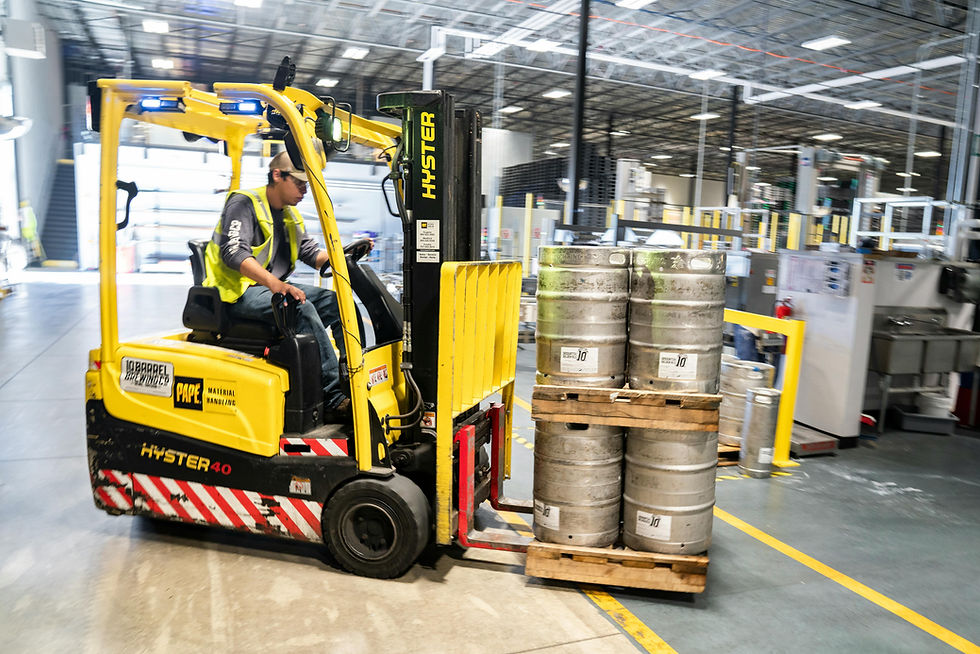
On-forklift safety solutions: what they do well, and what they miss
If you've started searching for forklift safety solutions, there's a good chance you've already landed on a page selling an on-forklift device. Impact sensors, speed limiters, proximity beepers, seatbelt interlocks, dashcams mounted above the operator's head.
These tools do real work. But if you're evaluating them as your main safety investment, it's worth knowing what they're designed to catch, what they miss, and where a different category of technology fits alongside them. (Spoiler: It's computer vision AI, using cameras you already have.)
The scale of the forklift problem (briefly)
Before we get into the tools, a grounding stat or two. In the United States, the Bureau of Labor Statistics, via the National Safety Council, reports that forklifts were the source of 84 workplace deaths in 2024 and more than 25,000 cases involving days away, restricted, or transferred work across 2023-2024. OSHA's analysis of powered industrial truck training data found that comprehensive operator training could reduce forklift accidents by around 70%, with roughly 34,900 serious forklift-related injuries recorded every year.
In Australia, the picture is similar. Safe Work Australia notes that most forklift incidents involve pedestrians and that the common triggers are excessive speed, heavy braking, overloading, tight turns, and moving with elevated loads, under a WHS duty to eliminate or minimise vehicle-pedestrian risk. State regulators echo it: in a recent five-year period, 10 workers were killed and more than 2,000 were injured in mobile plant incidents in NSW alone, and WorkSafe Victoria identifies pedestrian exposure, visibility, and speed as the dominant control priorities for forklift operations.
What on-forklift safety solutions actually do
Let's define the category. On-forklift (or on-truck) safety solutions are devices physically installed on the forklift itself. The main solutions are:
Impact and G-force sensors. These detect when the forklift has been in a collision or has been driven roughly, usually by measuring acceleration or sudden deceleration. They can trigger alerts, lock out operators, or prompt a supervisor sign-off before the truck can be used again.
Speed limiters and governors. These cap the maximum speed of the forklift. Some are fixed, some are zone-based (using GPS or RF beacons to reduce speed in specific areas), and some reduce speed dynamically in response to events like pedestrian detection.
Proximity detection systems. Digital checklists that must be completed before the forklift will start, and which can flag critical-item failures to a supervisor.
Pre-shift inspection lockouts. Digital checklists that must be completed before the forklift will start, and which can flag critical-item failures to a supervisor.
In-cab cameras and DVRs. Cameras mounted on the truck that record continuously or capture a short window around an impact event, usually for post-incident review.
Telematics platforms. The central dashboard that stitches all the above together, tracking operator ID, utilisation hours, impacts, speeding events, and inspection compliance.
This is a genuinely useful category of technology. Telematics brings real accountability to large fleets, speed limiters remove a whole class of risk that would otherwise rely on operator discretion, and pre-shift lockouts catch mechanical issues before they become incidents.
But here's where the gaps begin.
What on-forklift solutions tend to miss
These systems are optimised for the forklift. That's both their strength and their limitation. When your unity of analysis is a single machine, a few important things fall outside the frame.
They're mostly reactive
An impact sensor tells you something hit something. It doesn't tell you how the operator approached the blind corner fifteen seconds beforehand, whether they sounded the horn, when a pedestrian stepped out, or whether the near miss that happened yesterday in the same spot could have predicted today's collision. In practice, telematics tells you that something happened. It doesn't always tell you what happened, or why.
They only see the forklift's world
A vehicle-only system can't see the pedestrian walking down an aisle two aisles away, the unsafe stacking behaviour at the end of the shift, or the gate that's been left open. Yet pedestrian collisions and forklift turns are consistently among the highest-risk forklift events, per OSHA, and most of the behavioural patterns that precede a serious incident happen around the forklift, not only on it.
They struggle with the "why"
If your impact report tells you Operator A had three hard-braking events this month, you've got a data point. But you don't have the footage, the context, or the coaching moment. Was it a loading dock congestion issue? A new pedestrian route? A load too high to see over? Without a visual record tied to the event, supervisors end up guessing, and operators end up feeling surveilled rather than supported.
They're one device per truck
Retrofitting a full telematics and proximity detection setup across a fleet is a real capital project. Costs scale linearly with your fleet size, and the hardware itself adds wear, maintenance overhead, and integration complexity, especially across a mixed fleet of diesel, LPG, and electric trucks.
Alerts can become noise
Every on-forklift system has an alert threshold. Too sensitive and operators get beeped at constantly, which is the fastest known way to create alert fatigue. Too permissive and you miss the events that matter. Tuning this well across a mixed fleet and multiple sites is a genuinely hard job.
None of this means on-forklift tech is bad. It means on-forklift tech, on its own, is partial.

Where computer vision AI fits in
Here's where a lot of safety leaders have a quiet lightbulb moment (the phrase "I didn't know this existed" comes up a lot in our conversations). Computer vision AI is a different category of safety tool. Instead of living on the forklift, it runs on the CCTV cameras you already have watching your site.
A computer vision AI platform like inviol watches the footage continuously, identifies unsafe behaviours (a forklift taking a blind corner too fast, a pedestrian entering an exclusion zone, a near miss between a truck and a worker), and turns them into short video clips that a supervisor can use for coaching. Faces and people are blurred for privacy, 99% of the data stays on site, and the hardware that runs the AI is leased as part of the agreement.
A proximity beeper on a forklift tells the operator a pedestrian is nearby in this moment. A computer vision AI platform shows you that Aisle 4 has had eleven near misses between forklifts and pedestrians in the last two weeks, that nine of them happened on the afternoon shift, and that the root cause is a layout issue around the shrink-wrap station. That's the kind of insight that changes decisions.
And because the events are captured as short video clips rather than abstract data points, supervisors can coach with the actual moment in front of them. Using real, site-specific video beats generic safety content because operators can see themselves (or their colleagues, blurred) in the exact environment they work in.
On-forklift + computer vision AI: not either/or
To be clear: this isn't a pitch to rip out your impact sensors. Most inviol customers running forklift-heavy sites (logistics, cold storage, FMCG, retail distribution centres, and third-party warehousing) use both. Speed limiters and impact monitoring do a specific job on the truck. inviol does a different job across the whole site.
The combination looks something like:
Your on-forklift system handles the operational controls. Speed caps in key zones, seatbelt interlock, pre-shift inspection lockout, impact alerts above a set threshold. These are the hard guardrails.
inviol handles the behavioural and coaching layer. Near misses, pedestrian-vehicle interactions, exclusion zone breaches, patterns across shifts and sites. This is the feedback loop that actually changes how people work.
When the two run together, you get the reactive safety net and the proactive coaching program working hand-in-hand. That's how our customers are seeing up to 61% reductions in machine-on-plant incidents and meaningful drops in preventable damage.
The take-away
If you've been quoted an on-forklift system and it fits your budget and your risk-profile, that's a reasonable investment. What I'd gently push back on is the assumption that it's the complete answer. The OSHA-estimated 70% of preventable forklift accidents aren't going to be solved by devices alone. They get solved when supervisors have the tools, the data, and the coaching moments to change behaviour before the next incident, not just record the last one.
Computer vision AI isn't the only way to get you there, but it's the most efficient one we've seen, and it doesn't require you to replace anything you already have. It just uses the cameras already watching your site to do more of the work they were installed to do.
Thinking about whether inviol fits alongside your on-forklift safety investment? Have a chat with us and we'll show you what it would look like on your site.
Author
Louise von Benzon
Marketing Lead


Frequently Asked Questions
Do I need to replace my existing CCTV cameras to use computer vision AI?
In most cases, no. A modern computer vision AI platform can run on your existing IP CCTV infrastructure, which is a big reason the cost profile is so different from rolling out on-forklift hardware across a fleet.
Is this just a more advanced dashcam?
No. Dashcams record what the forklift sees. inviol watches what's happening across the site 9forklifts, pedestrians, zones, interactions), identifies the events that matter, and turns them into coaching-ready clips.
Does computer vision AI replace operator training?
Not at all. IT makes training better. Instead of generic modules, supervisors can use real footage from the site (with faces blurred) to coach operators on the specific situations they actually encounter.
Is it privacy-safe?
Yes, when it's built that way. Platforms like inviol blur faces and people by default, process 99% of data on site rather than in the cloud, and hold SOC 2, ISO 27001, and GDPR compliance. It's worth asking any vendor about their privacy architecture specifically, particularly if you operate across multiple jurisdictions.
What's the fastest way to see whether this would work for our site?
A short demo, honestly. You can book one here and we'll walk you through what it looks like.