Near misses involving forklifts: why tracking them matters more than incidents
Updated: Apr 14
Leading vs lagging: why the distinction matters
Traditional safety measurement is dominated by lagging indicators: incident rates, days away from work, workers' compensation claims, and OSHA recordable cases. These metrics tell you what has already happened. They're important for benchmarking and compliance, but they can't tell you what's about to happen.
Leading indicators, by contrast, are predictive measures that provide early warning signs of potential failures. Training completion rates, safety audit scores, and behavioural observations are all leading indicators. But near misses, when captured and analysed properly, are the most powerful leading indicator of all, because they represent the exact scenarios that will produce your next injury if conditions don't change.
The Campbell Institute makes an important distinction: if near misses are treated as incidents to be recorded and filed, they function as lagging indicators. But if they're used to find weaknesses in a safety management system and drive improvements, they become genuinely leading. The difference isn't in the data; it's in what you do with it.
The reporting gap that hides the real picture
The theory says you should track near misses. OSHA's near-miss reporting policy states that all near-miss incidents should be reported, recorded, and investigated. The reality in most warehouses is very different.
Consider a typical forklift near miss: an operator rounds a corner and comes within a metre of a pedestrian who stepped into the aisle. Both react in time. Nobody is hurt. The whole event takes two seconds.
Now consider whether that event gets reported. The operator is mid-task and under throughput pressure. Filing a near-miss report takes time. The pedestrian may not even have realised how close they came. Neither party has an incentive to stop what they're doing and complete paperwork for an event where nothing actually happened.
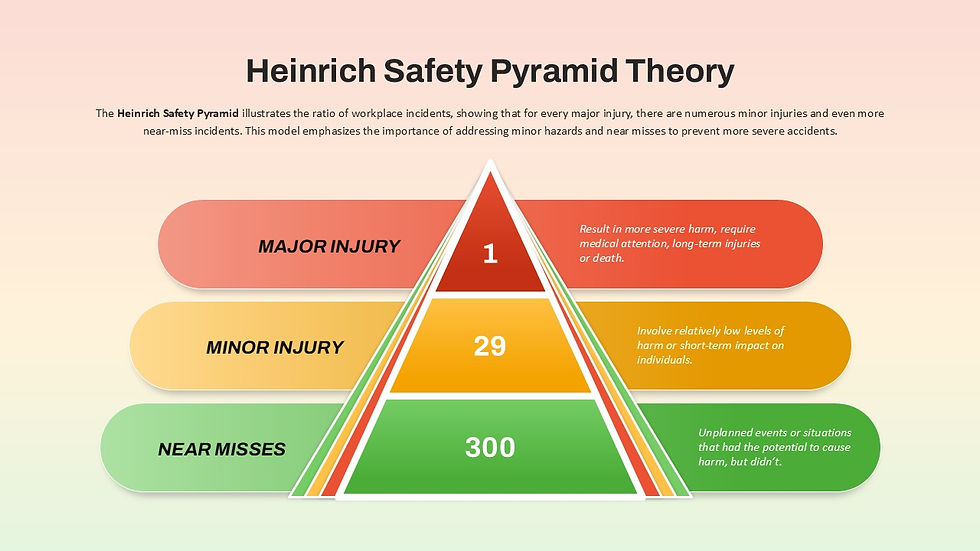
As one industry analysis puts it: near misses on forklifts are not usually tracked or reported, so nobody knows the real number. If a facility has 20 forklifts, each having multiple near misses per day, the actual near-miss count could be in the hundreds per week. The reported count might be zero.
This gap between what happens and what gets reported means safety teams are making decisions based on a tiny fraction of the actual risk picture. They see the incidents that were severe enough to be noticed and reported, but they're blind to the patterns that predict where the next incident will occur.
Why forklift near misses are uniquely hard to capture manually
Some industries have found ways to make near-miss reporting work through strong safety cultures and dedicated reporting systems. Forklifts present specific challenges that make manual reporting particularly ineffective.
They happen fast
A forklift-pedestrian near miss typically unfolds in one to three seconds. By the time both parties realise what nearly happened, the moment has passed. There's no evidence, no damage, and often no clear memory of the exact sequence of events. Reporting something that lasted two seconds and left no trace feels less urgent than getting back to the task at hand.
They happen constantly
In a busy warehouse, minor proximity events between forklifts and pedestrians happen throughout every shift. If every one were reported, the volume of paperwork would be overwhelming. Workers naturally filter for severity, reporting only the events that felt genuinely frightening and dismissing the ones that felt routine. But routine near misses are exactly the data points that reveal systemic risk.
Reporting feels punitive
Even in organisations that say they encourage near-miss reporting, workers often perceive that reporting a near miss will result in blame, investigation, or scrutiny of their behaviour. If the near miss involved the worker taking a shortcut or being in an area they shouldn't have been, the incentive to report drops further. The result is a systematic undercount that biases the data toward the most dramatic events while missing the everyday patterns.
What automatic near-miss capture looks like
Computer vision AI eliminates the reporting gap by capturing forklift near misses automatically, without relying on anyone to notice, remember, or file a report.

Continuous, passive detection
The system uses your existing CCTV cameras to monitor high-risk zones for events where forklifts and pedestrians come into unsafe proximity, where vehicles breach exclusion zones, or where speed violations occur. Every event is captured with a time-stamped video clip, regardless of whether anyone on the floor noticed it happened.
This isn't sampling or spot-checking. It's continuous monitoring across every shift, including the overnight shifts, weekend operations, and peak periods when supervision is stretched and near misses are most likely to occur.
From scattered events to structured patterns
The real power of automatic near-miss capture isn't in any single event. It's in what emerges when you aggregate hundreds of events over time.
The heatmap and reporting tools transform scattered, invisible near misses into structured data that answers the questions safety teams actually need answered. Which intersection generates the most forklift-pedestrian proximity events? Which shift has the highest near-miss rate? Has the near-miss rate at the dock increased since the new delivery schedule was implemented? Is there a correlation between speed violations and near-miss frequency?
These patterns are the leading indicators that predict where your next incident will occur. And unlike manually reported near misses, which are sparse, inconsistent, and biased toward dramatic events, automatically captured near misses provide a complete and consistent picture of risk across the entire facility.
Quantifying the invisible
One of the most powerful outcomes of automatic near-miss capture is the ability to quantify risk that was previously invisible. A safety team might know intuitively that the intersection near bay 7 feels dangerous, but they have no data to support that intuition. With continuous monitoring, they can say that intersection generates 47 near misses per week, three times the rate of any other point in the facility. That's the kind of evidence that drives investment in physical barriers, layout changes, or operational adjustments.
Turning near-miss data into behaviour change
Data alone doesn't prevent injuries. What matters is what happens after a near miss is captured.
Every detected event becomes the starting point for a coaching conversation. Video clips with faces blurred for privacy are shared with the team: here's what happened at this location on this shift, here's what could have gone wrong, and here's what we're going to change.
This is fundamentally different from asking workers to self-report near misses and then reviewing the reports in a monthly safety meeting. The coaching happens close to the event, uses real footage from the team's own workplace, and focuses on improving the system rather than blaming individuals. Workers engage because it's relevant, visual, and forward-looking.
Over time, the combination of continuous near-miss capture and consistent coaching produces measurable results. inviol customers typically see an average 67% reduction in risk and a 42% reduction in incidents across their sites, with a 61% reduction in machine-on-plant incidents specifically.

The shift from reactive to predictive
Traditional safety is reactive: you investigate after someone gets hurt. Near-miss reporting was supposed to make it proactive, but the reporting gap means most organisations are still working with incomplete data.
Automatic near-miss capture through computer vision AI closes that gap. It gives safety teams the complete picture of forklift risk in their facility, not just the incidents that were severe enough to be reported, but every near miss, every proximity event, and every pattern that predicts where the next incident will occur.
That's the difference between managing safety based on what already went wrong and managing it based on what's about to go wrong.
Getting started
Start by asking a simple question: how many forklift near misses occurred in your facility last week? If you don't know the answer, that's the gap computer vision AI is designed to fill.
The system works with your existing CCTV cameras, processes data on-premise for privacy, and gives your safety team the near-miss data they need to shift from reactive to predictive safety management.
Book a demo and we'll show you how it works for your warehouse.
Frequently Asked Questions
Why are forklift near misses important to track?
Near misses are the leading indicators that predict future incidents. They reveal the exact scenarios, locations, and patterns that will produce your next injury if conditions don't change. Tracking them allows safety teams to intervene before someone gets hurt, rather than investigating after the fact.
Why don't workers report forklift near misses?
Forklift near misses happen fast (one to three seconds), leave no evidence, and occur frequently throughout every shift. Workers under throughput pressure rarely stop to file paperwork for an event where nobody was hurt. Fear of blame or scrutiny further discourages reporting. The result is that the vast majority of forklift near misses are never captured.
What's the difference between leading and lagging safety indicators?
Lagging indicators measure what has already happened — incident rates, days away from work, workers' compensation claims. Leading indicators predict what might happen next — training completion, safety audit scores, and near-miss frequency. Near misses become leading indicators when they're used to identify weaknesses and drive improvements, rather than simply recorded and filed.
How does AI capture forklift near misses automatically?
Computer vision AI uses existing CCTV cameras to continuously monitor high-risk zones for events where forklifts and pedestrians come into unsafe proximity. Every event is captured with a time-stamped video clip, without relying on anyone to notice or report it. The system aggregates events into heatmaps that reveal risk patterns across the facility.
What results can you expect from tracking forklift near misses?
inviol customers typically see a 67% reduction in risk, a 42% reduction in incidents, and a 61% reduction in machine-on-plant incidents specifically. These results come from the combination of continuous near-miss capture and coaching conversations that use real events to drive behaviour change.