Forklift-pedestrian safety: why separation alone isn't enough
Updated: Apr 14
The separation ideal and the separation reality
The hierarchy of controls is clear: eliminate the hazard first, then isolate it, then use engineering controls, then administrative controls, then PPE. For forklift-pedestrian risk, elimination means removing the need for pedestrians and forklifts to share the same space. Isolation means physical barriers that prevent any interaction.
In theory, this works. In practice, every warehouse has zones where the two must coexist.
Pickers work in aisles where forklifts restock shelves. Supervisors walk the floor to manage operations. Maintenance staff access equipment in forklift zones. Loading docks bring forklifts, trucks, and pedestrians together by the nature of the operation. Even warehouses with dedicated walkways and barriers have crossing points where pedestrians step into forklift paths, because the work requires it.
The UK Workplace Regulations require separation wherever reasonably practicable, and where it isn't possible, crossings must be properly marked, signposted, and designed with clear sightlines. But compliance with marking and signposting doesn't guarantee compliance with behaviour. A painted line on the floor doesn't stop a worker from crossing it when they're focused on their task and a forklift is approaching from behind a rack.

The moments that matter most
Understanding where forklift-pedestrian interactions are most dangerous helps focus safety efforts where they'll have the greatest impact.
Intersections and blind corners
Wherever a forklift path crosses a pedestrian route or an aisle meets a thoroughfare, there's a convergence point that creates risk. Blind spots created by racking, stacked pallets, and stored goods mean that neither the operator nor the pedestrian may see each other until they're already in the same space. Mirrors and warning lights help, but they require both parties to look and react in time.
Loading dock transitions
The dock is where forklifts enter and exit trailers, trucks manoeuvre into bays, and workers cross the dock face. As we covered in our loading dock safety guide, 25% of all warehouse injuries occur at or near the dock. The transition between the controlled interior and the less controlled dock area is one of the highest-risk zones in any facility.

Shift changeovers and peak periods
When shifts overlap or throughput spikes, the density of both forklifts and pedestrians increases. More people are moving through the same space at the same time, and the cognitive load on both operators and pedestrians is higher. Speed violations, shortcut-taking, and distraction all increase during peak periods, which is why near-miss rates tend to spike during the busiest operational windows.
Reversing operations
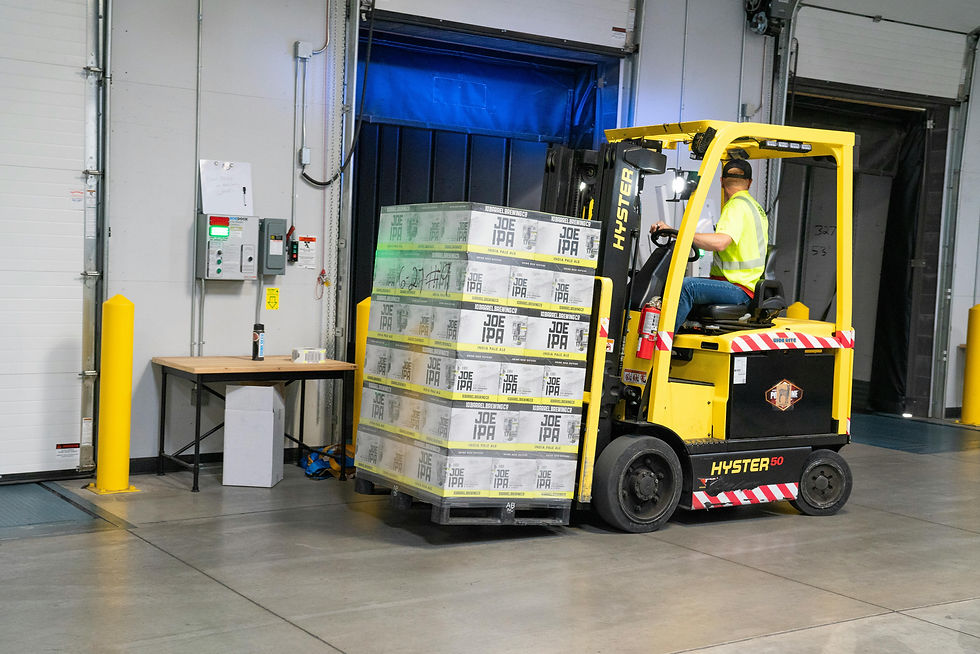
A forklift reversing out of a trailer or out of a racking aisle has severely limited visibility. The load, the mast, and the trailer walls all obstruct the operator's view. A pedestrian walking along the dock line or crossing behind a reversing forklift may not be visible until they're already in the path of the vehicle.
Why administrative controls have limits
Most warehouses address forklift-pedestrian risk with a combination of floor markings, signage, training, rules (such as "make eye contact before crossing"), and PPE like hi-vis vests. These are all necessary, and they form the baseline for safe operations.
But administrative controls depend on consistent human compliance. Every worker must follow the rules, every time, in every situation. In a fast-paced warehouse with throughput targets, fatigue, distractions, and the habitual confidence that comes from doing the same job day after day, consistent compliance is the exception rather than the norm.
The result is a steady accumulation of near misses that nobody sees, nobody reports, and nobody learns from, until one of them becomes an incident.
What continuous visibility changes
Computer vision AI addresses the gap that separation and administrative controls can't fill: the moments where forklifts and pedestrians share space and nobody is watching.
Capturing every interaction, not just the reported ones
The system uses your existing CCTV cameras to continuously monitor the zones where forklift-pedestrian interactions are most likely: intersections, dock areas, crossing points, and any zone where separation breaks down. It detects near misses, exclusion zone breaches, and speed violations across every shift, including the overnight shifts and busy periods when supervision is stretched thinnest.
Unlike incident reports, which capture only the events serious enough to be noticed and reported, computer vision AI captures the full picture: every near miss, every breach, every speed violation. This transforms scattered, invisible events into structured data.
Turning data into targeted action
The heatmap and reporting tools show exactly which zones, times, and patterns generate the most forklift-pedestrian risk. You might discover that a specific intersection generates ten times the near-miss rate of any other point in the facility. Or that near misses at the dock triple during a particular delivery window. Or that a pedestrian walkway is being bypassed consistently because it adds 30 seconds to the route between two work areas.
Each of these insights points to a specific, practical intervention: reposition a barrier, adjust a schedule, redesign a crossing point, or address a behavioural pattern with the team. These targeted changes are far more effective than broad reminders to "be careful around forklifts."
From near misses to coaching conversations
Every captured forklift-pedestrian event becomes the starting point for a coaching conversation. Video clips with faces blurred for privacy are shared with the team: here's what happened at this intersection on Tuesday at 2pm, here's what could have gone wrong, and here's what we're going to change.
This approach is fundamentally different from telling people to follow the rules. It shows them what actually happens on the floor, using real events from their own site. Workers engage because it's relevant to them, and the conversation focuses on improving the process rather than blaming individuals.
inviol customers typically see an average 67% reduction in risk and a 42% reduction in incidents, with a 61% reduction in machine-on-plant incidents specifically.

The layered approach
The most effective forklift-pedestrian safety programmes use a layered approach. Physical separation where achievable. Engineering controls (barriers, mirrors, lights, floor markings) where separation isn't complete. Training and administrative controls as the next layer. And continuous visibility through computer vision AI as the layer that fills the gaps the others can't reach.
No single layer is sufficient on its own. But together, they create a system where the moments of forklift-pedestrian interaction, the moments that drive the most serious injuries, are visible, managed, and continuously improving.
Getting started
Start with your highest-risk interaction points: the intersections, the dock, and the areas where separation breaks down most frequently. Computer vision AI works with your existing CCTV cameras, processes data on-premise for privacy, and gives your safety team the visibility they need to manage forklift-pedestrian risk continuously, not just when someone happens to be watching.
Book a demo and we'll show you how it works for your warehouse.
Frequently Asked Questions
Why is forklift-pedestrian separation not always achievable?
In a working warehouse, pedestrians and forklifts must share space at loading docks, aisle intersections, crossing points, and areas where pickers, supervisors, and maintenance staff work in forklift zones. While physical separation should be maximised wherever possible, complete elimination of interaction is rarely achievable in practice.
What percentage of forklift fatalities involve pedestrians?
36% of all forklift-related fatalities involve pedestrians, making it the number one cause of forklift work fatalities. Human error plays a role in 80 to 90% of all forklift accidents, which is why administrative controls alone are insufficient to prevent all incidents.
Where do most forklift-pedestrian near misses occur?
The highest-risk zones include aisle intersections and blind corners where racking obstructs sightlines, loading docks where forklifts enter and exit trailers, crossing points where pedestrian walkways meet forklift routes, and any area where reversing operations reduce operator visibility.
How does computer vision AI detect forklift-pedestrian near misses?
The system uses existing CCTV cameras to continuously monitor high-risk zones for events where forklifts and pedestrians come into unsafe proximity. It detects near misses, exclusion zone breaches, and speed violations across every shift, and aggregates this data into heatmaps that show exactly where, when, and how often interactions occur.
What is the layered approach to forklift-pedestrian safety?
The layered approach combines physical separation where achievable, engineering controls (barriers, mirrors, lights) where separation isn't complete, training and administrative controls as the next layer, and continuous monitoring through computer vision AI to fill the gaps the other layers can't reach. No single layer is sufficient alone, but together they create comprehensive protection.