Chemical warehouse safety: handling, storage, and AI monitoring
Updated: Apr 14
What makes chemical warehouses different
Every warehouse has hazards. What makes a chemical warehouse uniquely challenging is the compounding nature of the risks. A forklift collision in a standard warehouse damages a pallet. A forklift collision in a chemical warehouse can puncture a drum of corrosive liquid, create a toxic vapour cloud, or trigger a fire.
The chemical hazards themselves
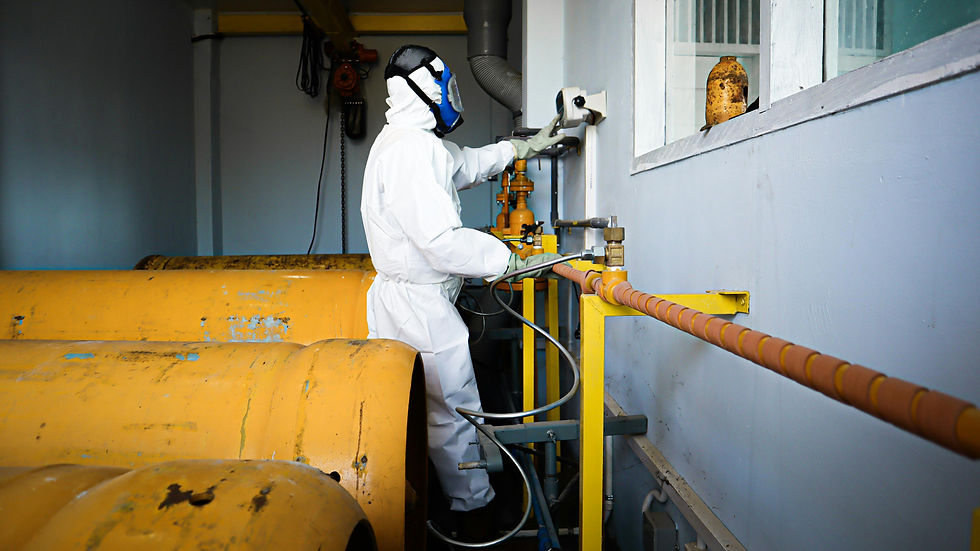
OSHA requires chemical warehouses to manage chemicals safely and securely to prevent workplace injuries, illnesses, and catastrophic accidents. The core chemical hazards include flammability (solvents, fuels, aerosols), toxicity (substances that cause harm through inhalation, ingestion, or skin contact), corrosivity (acids and bases that cause severe burns), reactivity (substances that can react violently when combined or exposed to heat), and oxidising properties (substances that can cause or intensify fire).
The complexity increases when incompatible chemicals are stored in proximity. A joint safety advisory from the US EPA and OSHA found that many chemical warehouses and distribution facilities do not manage chemicals in a safe or secure manner, with inadequate segregation, improper storage equipment, and failure to account for all hazardous substances on site.
Vehicle traffic in a high-consequence environment
Forklifts are as essential in a chemical warehouse as anywhere else. They move drums, IBCs, pallets of packaged chemicals, and bulk containers throughout the facility. But in a chemical environment, the consequences of a vehicle incident are amplified. A forklift striking a rack loaded with hazardous materials can cause a cascade that goes far beyond product damage.
OSHA estimates between 35,000 and 62,000 forklift-related injuries annually in the US across all warehouse types. In a chemical warehouse, even a minor forklift incident near incompatible materials can escalate rapidly into a situation that threatens the entire facility and surrounding area.

Spills, leaks, and exposure
Chemical spills can occur during receiving, storage, picking, or dispatch. They can result from container damage, forklift impacts, incorrect stacking, or deterioration of packaging over time. The immediate risks include chemical burns, respiratory exposure, and slip hazards from spilled liquids. The longer-term risks include chronic health effects from repeated low-level exposure, which is a significant concern in chemical warehousing where workers may not always realise they've been exposed.
Regulatory complexity
Chemical warehouses operate under multiple overlapping regulatory frameworks. In New Zealand, the Health and Safety at Work (Hazardous Substances) Regulations 2017 set out the rules for workplace activities involving hazardous substances, including requirements for inventory management, safety data sheets, PPE, emergency planning, and the segregation and storage of incompatible chemicals. PCBUs have a duty under HSWA to eliminate or minimise risks so far as is reasonably practicable, and WorkSafe enforces these requirements.
In Australia, Safe Work Australia reports that manufacturing was one of six industries accounting for 61% of serious workers' compensation claims, and the model WHS laws require businesses to manage chemical risks with the same rigour as physical safety hazards.
In the US, OSHA's Process Safety Management standard sets requirements for managing hazards associated with highly hazardous chemicals, with additional requirements from the EPA's Risk Management Program for facilities storing threshold quantities of regulated substances.
Where traditional safety approaches fall short
Chemical warehouses invest heavily in compliance: proper labelling, safety data sheets, segregation protocols, PPE, spill containment, and emergency response planning. These are all essential, and they form the foundation of safe operations.
But chemical safety has a visibility problem. A supervisor walking the floor can check that labels are correct and PPE is being worn, but they can't see the forklift that came too close to a rack of incompatible chemicals on the night shift. They can't see the pattern of near misses accumulating near the receiving dock over the past month. And they can't see the gradual behavioural drift where a shortcut that saves 30 seconds during picking slowly becomes normalised.
In a standard warehouse, these gaps create risk. In a chemical warehouse, they create the potential for catastrophic outcomes.
How computer vision AI adds a critical layer
Computer vision AI doesn't replace your chemical safety programme. It adds a layer of continuous visibility that your existing systems can't provide. Using your existing CCTV cameras, it monitors your highest-risk zones for the physical safety events that can trigger chemical incidents.
What it detects
In a chemical warehouse, the most relevant detections include pedestrian-vehicle near misses in areas where hazardous materials are stored or being handled, exclusion zone breaches near chemical storage racks, incompatible materials zones, or restricted areas, vehicle speed violations (particularly critical in environments where impact can cause spills or container damage), and patterns in how people and vehicles move through the facility across every shift.
The system focuses on your highest-risk areas, not every camera on site. In a chemical warehouse, those areas typically include the zones where hazardous materials are stored, the receiving and dispatch docks where chemicals are transferred, and the intersections where forklift and pedestrian traffic overlap near chemical storage.
Revealing the risks you can't see
The heatmap and reporting tools aggregate safety events over time, showing exactly where, when, and how often near misses are occurring. Many inviol customers discover that their existing processes, layouts, or schedules are creating more risk than they expected.
In a chemical warehouse, these insights are especially valuable. A heatmap might reveal that a particular aisle near the flammables storage generates significantly more forklift near misses than anywhere else on site, driven by a blind corner that's invisible to any single walk-through. Or that receiving dock activity during a specific delivery window creates congestion that increases the probability of a forklift impact near chemical racking. These are the kinds of patterns that lead to targeted, practical changes, often improving both safety and operational efficiency.
From detection to coaching
Every captured safety event becomes the starting point for a coaching conversation. Video clips with faces blurred for privacy are shared with the team: what happened, what could have gone wrong given the materials in the area, and what should change.
In a chemical warehouse, this coaching context is critical. A near miss between a forklift and a pedestrian in a general warehouse is serious. The same near miss in an aisle storing corrosive or flammable materials is potentially catastrophic. The coaching conversation reflects that context, helping teams understand not just the immediate risk but the downstream consequences specific to their environment.
inviol customers typically see an average 67% reduction in risk and a 42% reduction in incidents across their sites. In a chemical warehouse, those reductions have an outsized impact because the consequence of any single incident is so much higher.

Getting started
If you operate a chemical warehouse, start by identifying the zones where vehicle traffic intersects with your highest-hazard chemical storage. Ask whether you have continuous visibility into what happens in those zones across every shift, including nights and weekends. If the answer is no, that's the gap computer vision AI is designed to fill.
The system works with your existing CCTV cameras, processes data on-premise so sensitive footage stays on your site, and gives your safety team the leading indicators they need to prevent the next incident rather than investigate the last one.
Book a demo and we'll show you how it works for chemical and hazardous materials environments.
Frequently Asked Questions
What are the biggest safety risks in a chemical warehouse?
The biggest risks include forklift impacts that can puncture chemical containers, storage of incompatible chemicals in close proximity, spills and leaks during receiving and dispatch, exposure to toxic or corrosive substances, and fire or explosion from improper handling of flammable materials. 75% of hazardous materials emergencies occur in storage facilities.
How does AI monitoring improve chemical warehouse safety?
Computer vision AI uses existing CCTV cameras to continuously monitor high-risk zones for physical safety events like forklift-pedestrian near misses, exclusion zone breaches near chemical storage, and speed violations. It captures events across every shift and generates heatmaps that reveal risk patterns, enabling targeted process improvements before a chemical incident occurs.
What regulations apply to chemical warehouses in New Zealand?
Chemical warehouses in New Zealand are governed by the Health and Safety at Work Act (HSWA) and the Health and Safety at Work (Hazardous Substances) Regulations 2017. PCBUs must eliminate or minimise risks, maintain hazardous substances inventories, ensure proper segregation and storage, provide safety data sheets and PPE, and have emergency response plans in place. WorkSafe enforces these requirements.
Can AI detect chemical spills or gas leaks?
Computer vision AI is designed to detect physical safety events like vehicle-pedestrian interactions, exclusion zone breaches, and speed violations rather than chemical spills or gas leaks directly. However, by preventing the forklift impacts, rack collisions, and procedural failures that cause most chemical incidents, it addresses the root causes of spills and releases rather than just the symptoms.
How does coaching work in a chemical warehouse context?
When a safety event is detected, the video clip is captured with faces blurred for privacy and used as the basis for a team coaching conversation. In a chemical warehouse, the coaching includes context about the materials in the area, helping teams understand not just the immediate risk but the potential for escalation given the hazardous substances involved. This builds deeper safety awareness over time.